The Royal We
The surrender of the story that the “I” at the center of all this conflict is as solid and permanent as it feels.

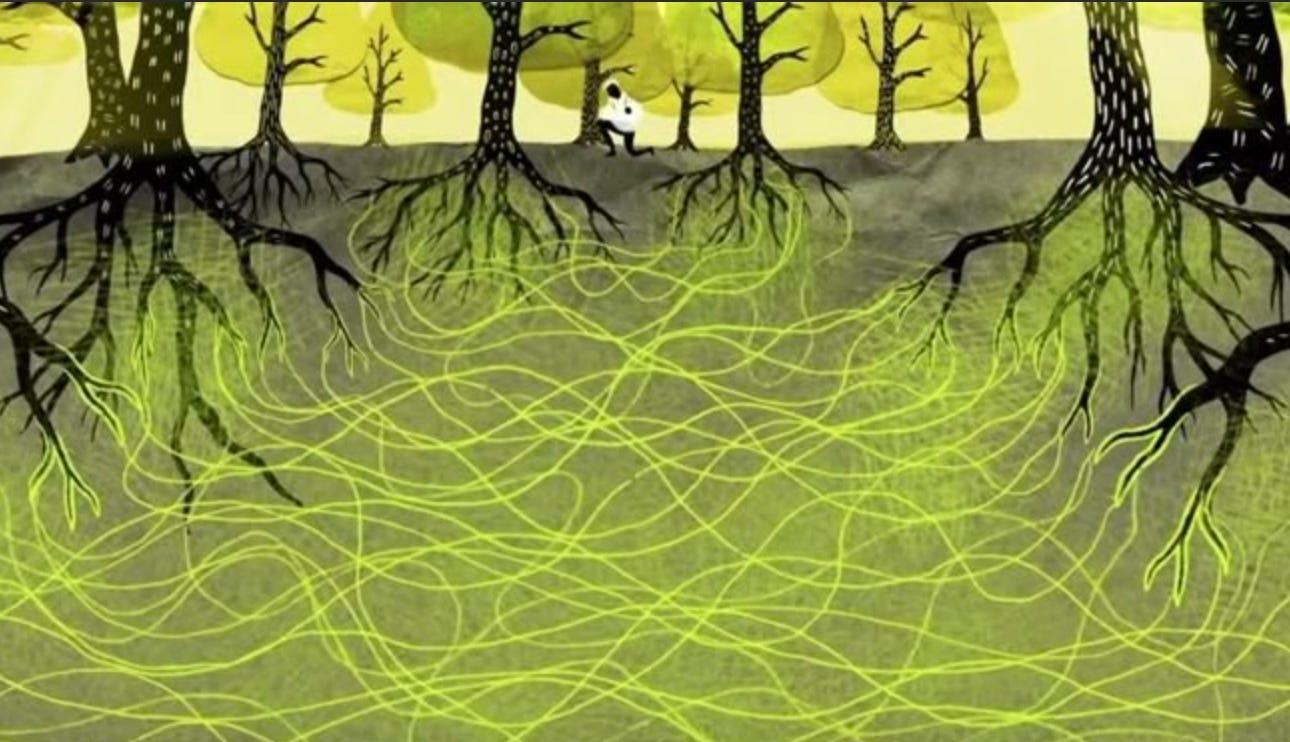
Ram Dass once offered that when he found himself sliding into judgment of others he would consciously turn people into trees.
When you go out into the woods and you look at trees, you see all these different trees. Some of them are bent, and some of them are straight, and some of them are evergreens. And you look at the tree and you allow it. You appreciate it. The minute you get near humans, you lose all that. That judgment mind comes in. And so I practice turning people into trees. Which means appreciating them just the way they are.
It has always been a favorite and potent insight for me in naming the unconscious judgmental activity within the mind. And by continuing with the tree analogy we can uncover even more, something underground that perhaps Ram Dass was gesturing toward without quite naming.
Because here is what we now know about trees: they are not separate.
What looks like a forest of individual trees, each one distinct, bent or straight, getting enough light or not, is, beneath the surface, a continuous system of shared nutrients and connectivity. The root networks intertwine. Trees under stress send signals through the soil, and neighboring trees respond, adjusting their own chemistry. There is little to no transaction between separate parties. There is one organism, expressing itself as many trees, from a vantage point that only becomes visible when you stop looking at what is above the ground.
The trees do not know this about themselves. They cannot see their own roots.
Is this our human situation? Above the surface: individual lives, individual histories, individual wounds and inheritances and opinions, all of it looking like separation, feeling like separation, insisting on separation. Yet below the surface of perceptions there is one continuous field of consciousness, undivided and expressing itself as the temporary appearance of you and me and everyone who has ever drawn breath.
Ram Dass took us to the tree. The Indian saint Ramana Maharshi takes us underground. There is no other, he said, as the simplest possible description of what is actually true. The moment there is a self, there is an other. The moment there is an other, there is threat. And the moment there is threat, the entire apparatus of protection and division and suffering powers on.
But beneath all of that, beneath the bent trees and the straight ones, beneath the ones that didn’t get enough light, the roots have never been separate.
The Royal We
We use the word “we” constantly, and there is little noticing that it is doing two completely different jobs.
The first “we” is the “we” of coalition. We the people. We are in this together. We will not be silent. This “we” is powerful, necessary, and, if we look honestly, inherently dualistic. Every coalition “we” draws a boundary somewhere. Every “us” generates a “them.” This is not a flaw in the people using it. It is structural. The coalition “we” is built from the root assumption that there are separate entities who must band together for mutual protection or purpose. It is the trees deciding to form an alliance, with no knowledge of what is happening underground.
All of this began formulating from a comment my husband made last week after we both climbed a significant number of stairs with luggage in an airport. We looked at each other and said, “We can do this,” and then began to regret the decision when it turned out to be many more flights up than anticipated. “We really need to get back to the gym,” he said jokingly as we both huffed and puffed. I sarcastically answered back, “What do you mean, WE?” bent over a bit and gathering air.
Laughing at each other when we caught ourselves, we said in unison: the royal we!
The phrase lingered in my mind, and I became drawn by how there could be another definition of it. The “we” that Ramana Maharshi was pointing at. The “we” that is not a gathering of individuals but the name of what we already are before the gathering. Not the “we” of solidarity but of identity. One organism that has temporarily forgotten it is one organism, arguing at the surface about which trees deserve more light. That is truly a royal we.
It is a bit daunting to write this at a time when the entire world feels increasingly threatened by authoritarian injustice. And yet that signals to me that it is precisely the condition under which it most needs to be said.
Look at what is happening in the world right now and you will see that the coalition “we” is running at full speed. “Choose a side” is the rallying cry. “Harden a position” is the daily practice. The us-and-them machinery is everywhere, in the news, in our feeds, in conversations that used to feel safe. And underneath all of it is a familiar desperation, the desperation of trees that cannot see their own roots, genuinely convinced that the survival of their particular trunk is the only thing that matters.
I am not saying the threats are not real. They are real. Democracy is fragile. Justice is grossly uneven. The people on the other side of whatever line you are drawing have often caused genuine harm. The bent trees did not get enough light, that is true, and it matters, and it has consequences that play out across generations.
And.
The root system does not stop at the boundary of any nation, any party, any tribe, any species. It runs underneath all of it. The question this Royal We is asking, quietly and persistently underneath the noise, is whether it is possible to act from that knowledge. It is not to abandon the surface, not to pretend the differences don’t exist, not to dissolve into a false unity that papers over real injustice. But to act from the roots while standing as a tree - to work for justice with the knowledge that the one you are working for and the one you are working against share the same underground network.
Is this what “we are the ones we’ve been waiting for” means, once you take it underground. It is not a rallying cry. It is a recognition. The waiting and the waited-for are the same movement. The rescuer and the rescued are the same root system, expressing itself as the appearance of two.
What does any of this mean to the person who is genuinely, completely, and understandably wrapped in the experience of separation? Who has been harmed by specific people, failed by specific systems, abandoned by specific bodies of power that had specific names and faces? For whom the root system is, at best, a beautiful idea, something that sounds true in a quiet moment and evaporates entirely the moment the conflict rises?
The nondual teaching, delivered prematurely, can become its own kind of violence. “There is no other” lands very differently in a meditation retreat than it does in the aftermath of genuine loss, genuine injustice, genuine threat. To hand someone the root system as a concept while their trunk is breaking is not liberation. It is abandonment wearing the costume of wisdom.
But isn’t the opposite equally true? To speak of liberation while refusing the root system is not freedom. It is a private escape dressed up as enlightenment.
The boundary does not usually dissolve through understanding. It dissolves through saturation, through conflict that has gone on long enough, at close enough range, that the story holding the separation in place simply exhausts itself.
History offers Christmas Eve, 1914, when British and German soldiers, without orders and without permission, climbed out of opposing trenches and met in no man’s land. They exchanged cigarettes, showed photographs of their families, played football in the mud, not because they understood each other differently, because the story had temporarily run out of fuel. What remained, when the narrative paused, was recognition. The generals were furious. The machinery started again on December 26th. But for that window, the oldest truth surfaced: these are men, like me, cold like me, wanting to go home like me. Every mystic tradition that has ever existed carries some version of this recognition, that the opening does not come when conditions improve. It comes when resistance finally costs more than surrender.
This is not surrender to the one who harmed you. It is not the capitulation that trauma survivors are so often asked to perform under the name of forgiveness. It is something quieter and more radical than that. The surrender of the story that the “I” at the center of all this conflict is as solid and permanent as it feels. The moment, and it almost always arrives as a moment rather than a gradual progression, when the boundary between self and other becomes briefly, unmistakably, transparent.
Most of us have had this moment and not known what to call it. A sudden unexpected tenderness for a stranger. The inexplicable grief you feel at a funeral for someone you barely knew. The way a piece of music can, without warning, make the walls come down completely. These are not anomalies. These are the roots making themselves briefly visible above the surface, the underground network sending up a signal that says: you are not as separate as you have been told.
The mystics call these glimpses. Ram Dass called them grace. What they are, structurally, is the temporary failure of the boundary maintenance system, a moment in which the tremendous effort of keeping me separate from you simply lapses, and what is always already true becomes briefly available to ordinary perception.
Conflict, at its extreme, can do this too. When the insurrection is complete, when the division has reached its fullest and most devastating expression, when the story of separation has played itself out to its logical and terrible conclusion, something cracks. Sometimes the very extremity of the rupture becomes the opening. The boundary, held too tightly for too long, gives way. And what is underneath is not the enemy. It never was.
This is not a reason to wait for catastrophe and it is not an argument for passivity in the face of injustice. It is simply the recognition that the Royal We does not arrive through argument or instruction. It arrives through the collapse of whatever has been holding the illusion of separation in place.
And that collapse, when it comes, does not feel like loss. It feels like the moment you finally stop holding your breath. Or, if you happen to be in an airport stairwell, the moment you actually can.
Thank you for connecting this so beautifully.
Grateful for the beautiful way you share your gifts with the world!