Snuggle Time With Eileen
On dying before you die, and what one small woman taught me about the only freedom that matters.

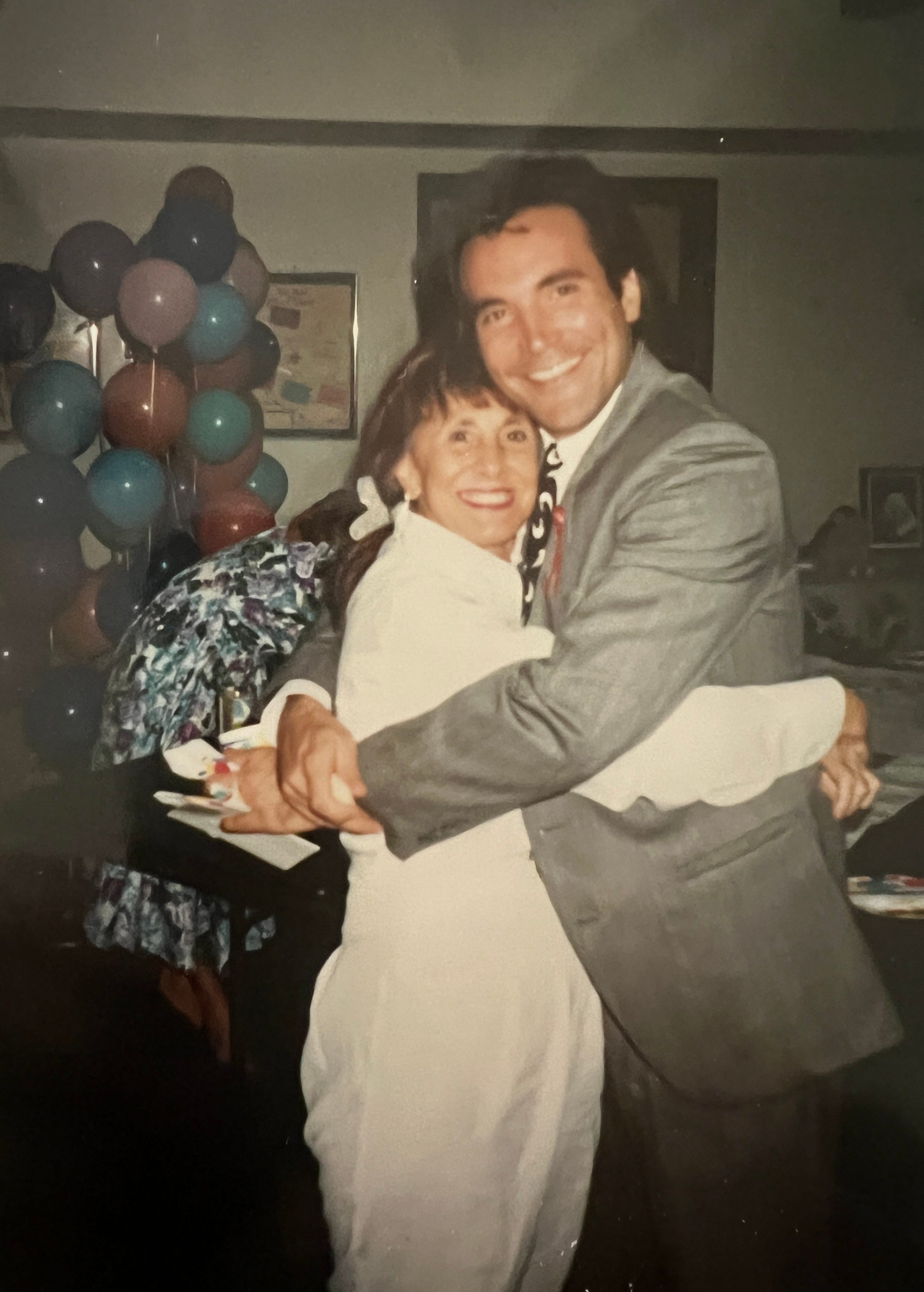
There is a hurdle on the spiritual path that nobody warns you about, particularly in the early days.
You can read all the texts. Sit with the teachers. Learn what Taoism calls the sky, what Ram Dass called loving awareness, what the biblical tradition points to when it says the I Am is what I Am. You can hold all of it and feel the truth of it. And still, most of the time, the small (s)elf just keeps running the show.
What actually shakes us loose is not the study. It’s the calamity. It’s the disruption so immense that it spring us out of the body, wakes (shakes) the sleeping Self with such force that we have no other choice but to bow. To begin to recognize that we are something so inexplicably vast, so interwoven, that the whole project of protecting this little costume we call a self starts to look almost absurd.
That is the linchpin. And it is the hardest and most thrilling thing I know to share with others.
Every time something gets labeled as self-referential, we suffer. Every time we contract into the protection of the small self, we suffer. And yet each disruptive circumstance, each difficult cast of characters, is also a portal - a gateway. And there is always a keeper of the keys.
Sometimes that keeper arrives cloaked in the most difficult costume imaginable - disease, loss, chronic pain, abandonment, betrayal. But if we’ve reached the place on the path where we can recognize, even shakily, that this too is a guru, that this too is a gatekeeper, then we can begin to ask: what must I do to walk through?
That’s where something like freedom begins to live.
And sometimes the gatekeeper doesn’t arrive as illness or loss. Sometimes it arrives as disillusionment. As the collapse of someone we placed on a pedestal so high that when they revealed their very human shadow, the fall felt like betrayal.
I’ve watched the recent unraveling around Deepak Chopra with a complicated heart. I’m not interested in relitigating the details. What fascinates me most is the outrage. My outrage. Yours. The collective grief of people who felt deceived by someone they trusted to be more than human.
Because here is what the small self does. It looks outside itself for proof. It finds a teacher, a voice that articulates the very freedom we are longing for, and without realizing it we hand them the keys to our own liberation. We make them the authority on something that was never theirs to hold on our behalf. And when they reveal that they too are inside a costume, navigating the full catastrophe of ego and shadow and desire, we call it betrayal.
But it isn’t betrayal to me. It’s the gatekeeper in a particularly humbling disguise.
The disillusionment itself is the teaching. The falling of the idol is the portal. The question, as always, is the same: what must I do to walk through?
Eileen never asked to be placed above anyone. She was too busy buying Fig Newtons.
Eileen Rankel came into my life in the late 1980s, woven into the Los Angeles world of Louise Hay and the Hayride community during the AIDS crisis. She wasn’t there because she was sick. She was there as a retired nurse, as the archetypal nurturer, because she wanted to be in the middle of that vast and painful battlefield doing whatever she could to love and to serve.
She became part of the support team around the trio I sang with, Alliance, when we appeared at events with Louise in California. With her small frame and squeaky little voice that always reminded me of Topo Gigio from the old Ed Sullivan show, she moved among us all with an inherent, unmovable calm. She was recognized throughout West Hollywood and greater Los Angeles for her AIDS advocacy, and she was on the care team alongside me under Louise’s guidance, going into people’s homes, doing what we could to ease the weight of it all.
Somewhere early in our friendship I mentioned that I loved Fig Newtons. Once. That was enough for Eileen. From then on, every event, every van ride, every gathering, her hand would reach into that enormous mother’s purse and pull out a travel-sized box. Just for me. We would laugh. I would share them. And I don’t know if I ever adequately told her what that gesture meant. It was the whole of her, really, compressed into a small cardboard box.
She once gave me a Christmas angel made of sturdy clear plastic that caught light like crystal, its lips pressed to a bugle, announcing some greater glory. I kept it out long after the season and placed it on my wall altar. That was Eileen. Whenever she walked into a room there was an announcement. She was a being so full of love that her arrival felt like something was being proclaimed.
So you can imagine what it meant when she told a small circle of us she had been diagnosed with an aggressive cancer.
And then told us she was not going to seek treatment.
I had never known anyone, up to that point in my late twenties, who had received that diagnosis and not gone into full throttle survival mode. But Eileen didn’t flinch. She spoke about reveling in the joy of having had that body and everything it afforded her. She was not interested in delaying or hiding anything because she was not attached to the small self. She had witnessed too much at the bedsides of AIDS patients. She had witnessed too much as a nurse. And she had arrived at some indiscriminate peace that perhaps this costume was never meant to struggle and fight to preserve itself.
She made a chart. She called it Snuggle Time with Eileen.
For whatever time she had left, a group of us were invited to schedule ourself, come over, and crawl into the bed beside her and just talk. Sometimes you could ask her anything. Other times, when speech was difficult, you would just lie there together and listen to music. She held open house for her own dying and made it an act of love.
Like most people who adored her, I wanted her to stay for selfish reasons. But she was there to show us something. A different embodiment of what it actually means to not be attached to the self. To celebrate impermanence not as a tragedy but as the whole point.
You and I may not have a diagnosis putting a period on this particular experience. But Eileen’s offering holds for all of us.
What she demonstrated was not some rarefied spiritual achievement. It was practical - the open hands, the open heart. The willingness to move through a dualistic and often brutal human existence without grabbing or pushing away. To serve even in the midst of the most painful battlefield. To keep the heart open. To still, in a Topo Gigio voice, giggle. To still buy somebody Fig Newtons.
That is what real non-attachment looks like lived out loud.
For those of us who linger longer in these costumes, the same invitation is there every morning we wake up inside this movie without knowing when the credits roll. The same celebration is available. The same intentionality of a snuggle time, of actively being with another, of showing up and dissolving just a little more of the ego’s grip on our motives and agendas and the way we move through the world.
When that grip loosens, even for a moment, the veil lifts just enough. And what gets revealed underneath all the protecting and performing is this: you are that sky. You are that loving awareness. And from that place, the service, the advocacy, the quiet acts of Fig Newton buying, become endless.
Thanks, Eileen. I love you so.