
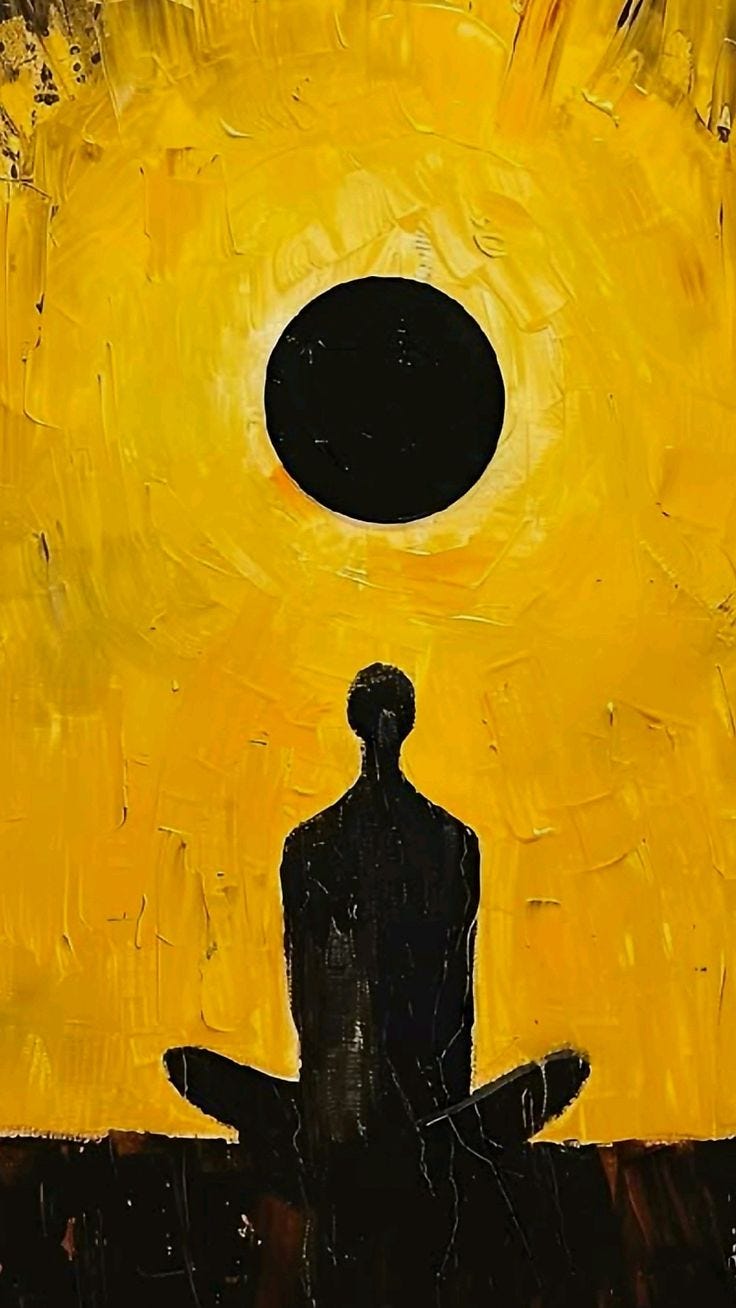
So much of human life seems to run on a kind of collective patterning in which we have almost no appreciation for balance. Why do we seem to rarely disrupt a habit until it has carried us to the brink of the extreme, until we are, in a sense, forced to? Such is the mandatory rest, one I imagine we’ve all had to experience at some point. But lately there is another rest I’ve been contemplating and practicing alongside those I teach. It is a rest quite different from the kind that is seemingly forced after we’ve been broken down.
This rest is not about getting more sleep. It’s not the vacation-style pause we schedule between efforts, or the reward we grant ourselves once everything is finally handled, since, as you may have noticed, everything is never finally handled. This is not a resting from so much as a resting inside. A resting in the very midst of the chaos.
Rest, in this way, is what remains when we stop mistaking ourselves for a mere body.
Yes, there is a you and a me that appears as the body. Let’s call it the actor. The actor “you” is always managing, racing, bracing, the one with your name and your history, the one keeping all the plates spinning. You might understand it as the small self. It is the relative instrument by which you experience life on this human realm.
I, for example, am the actor David, and I have a complete story of family, lineage, religion, suffering, victory, and on and on. It is real enough, and I don't dismiss or make light of any of the journey. But it is the journey of a me that is only relatively real, in the way a character in a film is real, and it is not the entirety of what I am. For there is also the absolute: the pure essence that is simply aware of all that the actor is managing and racing toward, the quiet witness that has been watching my life unfold from behind my eyes since I was a child. This is what the contemplative traditions call our authentic self. If you and I were not merely speaking about oneness but truly surrendering into it, this is what we would find. Just awareness, and nothing outside of it. That watching presence never panics. It never hurries. It is not the actor; it is the awareness in which the whole movie is appearing.
Many beings spend lifetimes operating in the illusion that we are only the actor, the finite, effortful, worth-proving character in the human drama. It is an irony that this state is also called the great sleep, for within all that pervasive dulling we never actually rest, because the character has a great deal to defend. But when an enlightenment breathes its way back into our consciousness, when the dulling dissolves, when there is a reawakening from the great sleep, the small self is finally seen clearly for what it is, and the efforting softens. We unbind from the finite, settling back into the one who was only ever watching. Rest, in this sense, is not something you do. It is something you already are.
This rest might be understood as witnessing. It’s the one that notices, “look at me, spiraling into panic again,” while the actor does the spiraling. It isn’t judging the spiral, and it isn’t rushing to fix it or change it. It is simply, restfully, aware.
This is acceptance at its most profound. I sometimes call this form of acceptance the gracious thief, the acceptance that quietly steals away the exhausting job of defending a small self whose worth I long believed I had to prove. I can rest the need to defend. I can rest, as A Course in Miracles puts it, in the discovery that “in my defenselessness my safety lies.”
T. S. Eliot named this beautifully in a 1935 poem called Burnt Norton, a meditation on time, memory, and the eternal present, set in a garden surrounding a decaying cottage. At the still point of the turning world, he wrote, “there would be no dance, and there is only the dance.” He means the way a spinning wheel needs a motionless center: there is no dance without the still point, and yet all we ever see is the dance. And then he writes this:
To be conscious is not to be in time
But only in time can the moment in the rose-garden,
The moment in the arbour where the rain beat,
The moment in the draughty church at smokefall
Be remembered; involved with past and future.
Only through time time is conquered.
Only through time time is conquered.
Awareness itself never moves. It has never once hurried, never been early or late. It has never been built, and it has never decayed. Everything you have ever experienced, including every experience of rushing, has appeared inside something perfectly still. And yet it is only in time, in those shimmers of enlightenment where the thinking mind ceases long enough, in the middle of the rose-garden and the rain and the ten thousand appointments, that the stillness gets recognized at all. We do not reach the timeless by escaping our schedules or waiting for a calmer season. Time is not the enemy of the timeless. Time is where the timeless is met. The intersection is here, in the very hour you were planning to hurry through.
Which means the spiritual fantasy so many of us carry, “once things slow down, then I’ll rest,” has it exactly backward. There is no “once things slow down.” There is only this moment waiting to be noticed. To borrow from Robert Frost, the way beyond is always through.
The still point is found on the turning wheel and never off it; the one who waits for a calm life before resting will wait forever, because the rest is only ever available inside the noise. We gain a settled inner life precisely by surrendering the demand to control the outer one, strength arriving through yielding, not through finally arranging the world to our liking. We discover the awareness we already are not by bypassing the striving self but by turning toward it and seeing clear through it. The seed must be buried in the dark to reach the light. To find your life, Jesus said, you must first lose it. Water carves stone by yielding to it. The wound, as the poets keep insisting, is where the light enters. And grief, grief moves through us only when we consent to feel it; the peace we ached for turns out to have been waiting on the far side of the sorrow, reachable by no road but straight into it.
In the human curriculum, transcendence never means escape. The timeless is not somewhere else. It is this world, fully entered: only through time is time conquered.
For most of us, this recognition rarely arrives elegantly. It arrives through exhaustion. There is a wearing down that seems to have to happen in the realm of time, a habitual hustling, before we finally allow the rest we claim to want. We manage time, negotiate with it, optimize it, fight it. We run the strategy for years, sometimes decades. And the strategy has to fail thoroughly enough, has to grind us finely enough, before the amnesia of our absolute nature fades and the costume of the actor is finally taken off. Exhaustion, then, isn’t a punishment. It is the relative self’s coping strategy completing itself. The self that believes it can win against time has to be allowed to run its whole campaign, and lose, before rest stops looking like defeat and starts to look like home. Only by being worn down in time do we become willing to notice what was never worn at all.
I am a year into leading a course on awareness, and we have just spent four weeks on nothing but the still point, the very stillness I have been describing to you. And, as is the nature of the best lessons, the humbling ones, somewhere in the middle of teaching it I forgot I wasn't the actor David.
It wasn’t a single act of forgetfulness. It was a dusting of them, each settling into the next until they built up a layer: seeming dead ends, a global education nonprofit to keep alive, a promising offer I let myself get excited about that quietly went nowhere, physical struggles, the plain wear and tear of being a person in a body. And underneath all of it, an old machinery came roaring back to life. That part of me, the one hardwired for doing and for proving, got turned all the way up this month. And I lost myself in it more than once, certain that if I just did more, managed harder, pushed longer, I could keep the crumbling things from crumbling.
So yes, there is something almost laughable about a man teaching a course on awareness while frantically trying to wrestle his life into submission. But how perfect that I get to build lessons with my students week after week, offering examples and guidance about the still point, only to continue remembering that I am practicing right alongside them.
Only through time time is conquered.
So I am pausing much within each hour. I breathe. And I remember that I am wearing a costume. From this I have tasted the rest.
It did not come from running from the role. It was not about stopping the work. It was about stopping the belief that I am the one doing the work: that the work needs me, this small striving character, in order to get done.
I know how that sounds. But it is really quite magical.
It is, in the end, the most famous teaching of the Bhagavad Gita: that we are to do the work, fully, devotedly, with our whole heart, but that we are not here to grasp at the fruits of it. “You have a right to your actions,” Krishna tells Arjuna, “but never to the fruits of your actions.” Act, and let the harvest belong to something far larger than the actor. That release, of outcome, of ownership, of the whole exhausting fantasy that the universe is somewhere waiting on my performance, turned out to be the doorway to the rest I could not manufacture by trying.
So this is what I have relearned, out on the far edge of a hard month: the still point was never something I had to build. It was here the whole time, underneath the bracing, one breath beneath the fight: the part of me that was never in the argument to begin with.
Rest. Notice what your body does when you say the word slowly. Notice, too, the small argument that rises up: not yet, not with everything I have going on.
That argument is the whole trance. And the still point is right behind it, turning quietly, waiting for you to stop waiting.